
Add modern auth to your stack. %%Without re-architecting it.%%
Authsignal layers passkeys, adaptive MFA, and omnichannel verification on top of your existing identity provider, or called wherever your business logic sits. Pre-built UI for fast deployment. Headless SDKs for full control. One API surface across the full customer journey. Live in days.










The problem you're solving
Your team spent years building the identity stack. Now the business needs passkeys, adaptive MFA, omnichannel verification, and FIDO certification. Building it means a multi-year engineering investment, SOC 2 + ISO 27001 compliance from scratch, and edge cases across hundreds of device types. Buying a full-stack CIAM platform means migrating users and re-architecting what works.
Authsignal is the third option: %%drop in modern authentication capabilities on top of your existing identity provider without creating a second source of truth.%%
How Authsignal fits into your stack
Orchestrate authentication at any point in the customer journey. Login, transactions, account recovery, sensitive actions.
Why engineering teams choose Authsignal
Drop in, don't re-architect
The no-code rules engine lets product and fraud teams define step-up logic, run experiments, and adjust thresholds. You build the integration once. They own the ongoing optimization.
Rules without deploys
The no-code rules engine lets product and fraud teams define step-up logic, run experiments, and adjust thresholds. You build the integration once. They own the ongoing optimization.
One API, every channel
Web, mobile, call center, in-person. Single orchestration layer. One integration to build, every touchpoint covered.
Ship certified
SOC 2 Type II, ISO 27001, FIDO Certified. Skip the months of compliance work and ship enterprise-grade auth from day one.
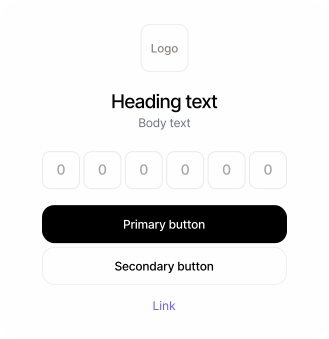
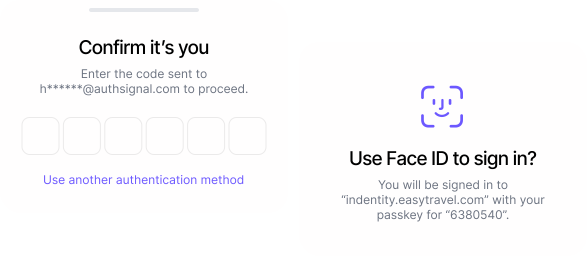
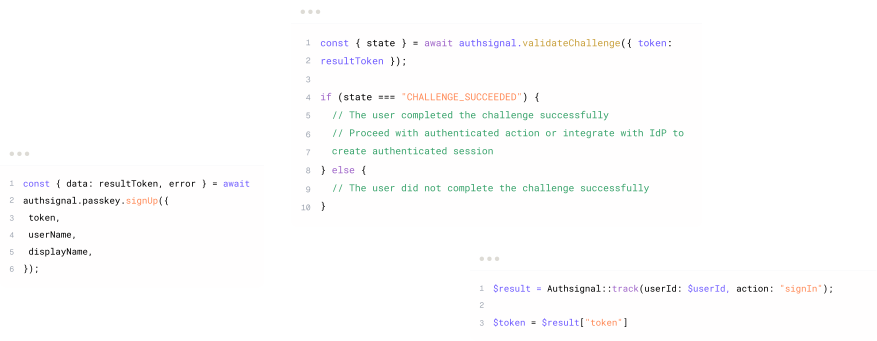
Three ways to integrate. You pick the depth.
The Rules Engine: flexible, code-free control
Adapt your auth logic without touching production code.
It's like feature flags, but for authentication.
Your product and fraud teams define the rules. You build the integration once. Changes ship without your involvement.
You could build it. %%Here's why teams don't.%%
The login screen looks simple. The 90% below the waterline is not: edge cases across hundreds of device types, cross-device passkey recovery, transaction signing, account recovery flows, regulatory compliance across jurisdictions. That's a multi-year engineering investment. And you still need SOC 2 + ISO 27001 + FIDO certification.
Authsignal handles the hard infrastructure. Your team owns the integration and the business logic. One API surface extends your existing identity platform without creating a second source of truth.
“Deploying passkeys has enhanced our security and accelerated our transition to a passwordless login experience, streamlining the customer journey.”
CTO · Simplicity
Works with your identity stack, or gives you the foundation to build one.
Authsignal drops in on top of your existing IdP. One API surface extends your identity platform across the full journey. Pick your integration guide and start building.


Enterprise-grade compliance out of the box. So you don't have to build it.
SDKs for your stack
Frequently asked questions
Authsignal sits on top of your IdP via API. We support Auth0, AWS Cognito, Azure AD B2C, Keycloak, Okta, Ping, Duende, ForgeRock, and WSO2. Your user directory stays where it is. No migration required. One API surface extends your identity platform across the full customer journey.
No. Authsignal is databaseless. We don't store user credentials or create a new user directory. We connect to your existing user model via API.
Authsignal is designed with graceful degradation. If the service is unavailable, your existing IdP continues to handle authentication. Authsignal adds capabilities; it does not replace your auth stack.
Most engineering teams have a proof of concept running in days. Full production deployment depends on scope, but the pre-built UI path can be live in under a week. Headless SDK integrations typically take 2-4 weeks.
Ready to ship?
One API. Your existing IdP. Passkeys, adaptive MFA, and omnichannel verification live in your product, not on your roadmap.