


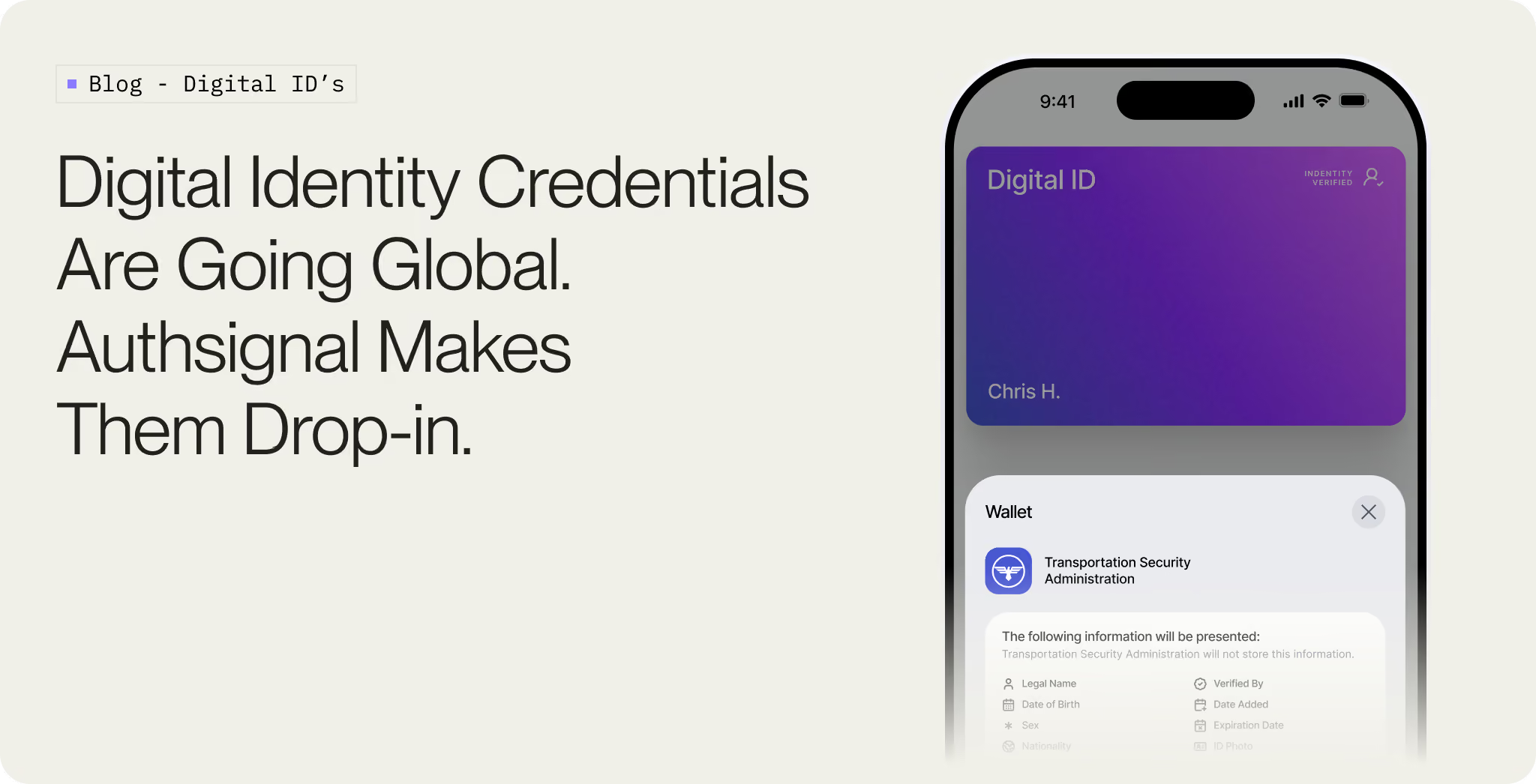
Digital credentials are rolling out globally. Here's how businesses can be ready to accept and verify them without rebuilding their identity stack.
Digital credentials are no longer theoretical
For years, the concept of a digital driver's license or a digital identity credential has lived mostly in policy papers and pilot programs. That's changing fast.
Across the United States, more than 20 states currently support mobile driver's licenses, with several more expected by the end of 2026. The EU mandates that all member states offer digital identity wallets by the end of this year under eIDAS 2.0, and service providers will be required to accept digital credentials by 2027. Apple Wallet and Google Wallet already support mobile driver's licenses and government-issued credentials in multiple jurisdictions. Australia has committed AUD $288 million to expand its national digital ID system. In New Zealand, the Digital Identity Services Trust Framework took effect in July 2025, with digital driver's licenses, the digital Kiwi Access Card, and Business Director credentials on the near-term horizon.
The infrastructure is being built. What's been missing is a straightforward way for businesses to accept and verify these credentials without a major engineering project.
That's what Authsignal's Digital Credential Verification delivers.
What is a digital credential, and why does it matter?
A digital credential is a cryptographically signed, identity-bound representation of identity claims issued by a trusted authority. Think of it as the digital equivalent of a physical driver's license or passport, except every claim is independently verifiable, the credential is cryptographically bound to its rightful holder, and the holder controls exactly which fields they share.
Three properties make a digital credential meaningfully different from a photo of an ID or a self-asserted claim:
Issuer authenticity. The credential is signed by the issuing authority, and that signature chains back to a recognized root of trust (for example, a government certificate authority). A verifier can confirm the credential was genuinely issued by the claimed authority.
Tamper evidence. The identity claims are hashed and committed to in an issuer-signed structure. Any alteration (changing a name, a date of birth, an address) breaks the hash chain and fails verification.
Holder possession. At presentation time, the wallet produces a fresh cryptographic proof signed by a hardware-bound key on the holder's device. A stolen credential response cannot be replayed. The person presenting the credential must have the device it was issued to.
The holder also controls disclosure: a verifier requests specific claims, and the wallet reveals only those claims. The issuer's cryptographic signature holds even when only a subset of fields is shared. This is selective disclosure, and it's one of the most powerful features of the digital credentials model.
ISO mdoc: the standard behind digital identity credentials
The digital credentials ecosystem has two main format families: ISO mdoc (defined by ISO/IEC 18013-5 and the ISO 23220 series) and W3C Verifiable Credentials (the W3C VC Data Model in its JWT and JSON-LD variants).
Both can encode identity claims and support selective disclosure. They differ in adoption, encoding, and the assurance level that issuers are willing to certify against.
The credentials businesses will encounter first are overwhelmingly mdoc. Mobile driver's licenses issued by AAMVA member states across the US, several Australian states that already offer mDLs and digital photo IDs with others transitioning or launching, NZ digital driver's licenses, and the digital Kiwi Access Card all use the mdoc format. Some EU PID credentials will also use mdoc, while others will use the W3C Verifiable Credentials format. Apple Wallet and Google Wallet treat mdoc as first-class. The browser Digital Credentials API on iOS currently accepts only mdoc-encoded credentials.
Authsignal's Digital Credential Verification is built mdoc-first, because that's where the credentials are. The architecture supports any ISO mdoc digital credential, not just government-issued ones, positioning businesses to accept credentials from a broadening ecosystem as it matures.
What Digital Credential Verification does
Digital Credential Verification provides a single integration point for businesses to accept and verify digital credentials. The verification flow works like this:
- The business requests verification, specifying the fields needed. For example: "confirm this person is over 18" or "verify their name and date of birth." Only the requested fields are included in the presentation.
- The user presents their credential from their wallet. Digital Credential Verification supports Apple Wallet, Google Wallet, standards-based government wallets including the Govt.nz wallet, and any compatible wallet that implements the relevant presentation protocols. The user sees a consent screen showing exactly which fields will be shared, and only those fields are disclosed.
- Optionally, biometric holder verification confirms the person presenting the credential is the real holder. Orchestrated through Authsignal's biometric vendor marketplace, the verification performs a live face match between the credential's portrait photo and the user's real-time selfie. iProov's Genuine Presence Assurance technology is the launch provider for this capability.
- The verification result is returned to the business application. A cryptographically verified result: not a probability score, not a fuzzy match against a document photo, but a deterministic answer backed by the issuing authority's signature and the holder's device-bound proof.
The integration is wallet-agnostic. It works across Apple, Google, government, and third-party wallets. It supports same-device presentation (the user is on their phone, the wallet opens natively) and cross-device presentation (the user is on a desktop, a QR code bridges to the wallet on their phone). Authsignal's pre-built UI provides the fastest deployment path, and the developer-friendly integration drops into existing identity stacks, the same architectural approach Authsignal customers already use for passkeys and adaptive MFA.
Biometric holder verification: the marketplace model
A digital credential proves three things: it was issued by a trusted authority, it hasn't been tampered with, and it was presented from the device it was bound to. But it doesn't prove, on its own, that the person holding the device right now is the person the credential was issued to.
For low-risk interactions (confirming a customer is over 18 to purchase a bottle of wine) the device-binding guarantee may be sufficient. For high-assurance use cases like financial services KYC, account recovery, and high-value transactions, biometric holder verification closes the gap.
Authsignal orchestrates biometric holder verification through its biometric vendor marketplace. The marketplace architecture allows businesses to configure the biometric provider that best fits their requirements, with the platform designed to support multiple best-of-breed vendors. At launch, iProov's Genuine Presence Assurance technology provides the biometric binding layer, performing a real-time face match between the portrait photo embedded in the credential and the user's live selfie. This confirms the credential holder is the real person, blocking stolen devices, shared wallets, and deepfake attacks. Portrait images are processed transiently and are not retained after verification.
This isn't a new partnership. Authsignal and iProov announced their global strategic partnership in June 2025, integrating iProov's Biometric Solution Suite into the Authsignal platform. Digital Credential Verification extends that collaboration into a concrete new capability, with the marketplace model ensuring businesses aren't locked into a single biometric vendor as the ecosystem evolves.
iProov's technology is used by the US Department of Homeland Security, the UK Home Office, the UK National Health Service, the Australian Taxation Office, and GovTech Singapore, among others.
Use cases
Age verification. Digital credentials support fields like age_over_18 as a simple boolean. The verifier sees only the answer, not the customer's date of birth or any other identity information. This is instant, cryptographic age confirmation without exposing full identity, applicable to online alcohol and tobacco purchase, gambling registration, age-gated event ticketing, and any context where a business needs to confirm a customer meets an age threshold. With age assurance regulations accelerating globally (25 US states have now adopted some form of age verification legislation, the UK's Online Safety Act is being enforced, Australia's Social Media Minimum Age requirement is live, and New Zealand is building an age assurance credential for its government-issued digital wallet) the demand for privacy-preserving, cryptographically backed age verification is growing fast.
KYC and onboarding. A digital credential collapses the traditional KYC checklist (document capture, selfie, liveness check, document verification, fuzzy match) into a single cryptographic verification. The result is faster, deterministic, and higher assurance than heuristic document-detection vendors. Use cases include bank account opening, fintech registration, telco SIM activation, and insurance onboarding.
Consumer financial services step-up. The same credential that onboarded a customer can authenticate them at high-risk touchpoints throughout the relationship. A verified digital driver's license becomes a step-up factor stronger than SMS, stronger than email OTP, and harder to phish than cross-device passkeys. Applicable to high-value transaction approval, new payee additions, and periodic KYC refresh.
Account recovery. A customer who has lost access to their account can prove ownership with their digital credential. No passwords, no SMS codes, no phone support queues. The credential provides a cryptographic proof of identity that is stronger and faster than any legacy recovery flow.
Business verification. Business Director credentials, like those being developed by MBIE in New Zealand, can prove authority to act on behalf of a business. This collapses days of documentation back-and-forth for B2B account onboarding, corporate banking, and regulatory filings into a single verified presentation.
NZ Government Marketplace listing
Authsignal is now listed on the NZ Government Marketplace under the new Digital Identity channel, established under the Digital Identity Services Trust Framework Act 2023. This means NZ government agencies can engage Authsignal as a digital identity service provider through the government's standard procurement channel. The listing covers Authentication Services, Binding Services, Information Services, and Verification Support Services.
The Digital Identity channel represents the NZ Government's recognition that digital identity services are becoming core infrastructure. Being listed alongside this new channel positions Authsignal as a trusted provider in the emerging NZ digital identity ecosystem.
What's next
Justin Soong, Authsignal's Founder and Director of Product, will be speaking on the panel "Enabling Better Customer Experiences: Digital Identity in Action" at the Digital Trust Hui Taumata in Wellington on August 11, 2026. The panel will explore what digital identity unlocks for everyday customer journeys, the practical question that sits behind every credential standard and every trust framework.
If your team is evaluating how to accept digital credentials, we'd welcome the conversation.
Explore Digital Credential Verification →
Digital Trust Hui Taumata, 11 August 2026, Te Papa Tongarewa, Wellington →
.svg)

.png)
