Contact salesSign inSign up
AuthsignalAuthsignal
Product
Passwordless / multi-factor authentication (MFA)
Drop-in authentication
Passkeys
Biometric authentication
Risk-based authentication
WhatsApp OTP
Authenticator apps (TOTP)
App verification
Push verificationQR code verificationIn-app verification
SMS OTP
Email OTP
Magic links
See all authenticators
See less authenticators
Palm biometrics
Contactless payments & identity verification
Flexible integration modes
Pre-built UI
Low code
UI components
Customizable
Custom UI
Flexible
Digital credentials API Beta
Authenticate customers instantly using digital credentials
Session management
Keep users signed in across web and mobile after authentication
Fraud Controls
Rules and policies engine
Step-up authentication
No-code rule creation
Risk alerts
User observability
Audit trails
Dynamic linking
Why Authsignal?
Complete authentication infrastructure from enrollment to step-up auth, modular by design
Solutions
By USE CASE
View All
Account takeovers (ATO)
Go passwordless
Call center
SMS cost optimization
Existing apps
QR code payments
Step-up MFA
Palm biometrics payments
By INDUSTRY
View All
Financial services
Marketplace
e-Commerce
FinTech
Crypto
Healthcare
By Integration (identity provider)
Amazon Cognito
Azure AD B2C
Duende IdentityServer
Keycloak
Auth0
NextAuth.js
Custom identity provider
By ROLe
Engineers
Product
Passwordless / Multi-factor Authentication (MFA)
Flexible Integration Modes
Pre-built UI · Low code
UI Components · Customizable
Custom UI · Flexible
Digital credentials API Beta
Authenticate customers instantly using digital credentials
Session management
Issue JWT access and refresh tokens
Why Authsignal?
Plug in Authsignal to elevate your IDP — effortless integration with any architecture.
Drop-in Authentication
Passkeys
Biometric authentication
WhatsApp OTP
Risk-based authentication
SMS OTP
Email OTP
Magic links
Authenticator apps (TOTP)
Push notifications
App verification
Push verificationQR code verificationIn-app verification
Palm Biometrics
Contactless payments & identity verification
Fraud Controls
Rules and Policies Engine
Step-up Authentication
No Code Rule Creation
Risk Alerts
User Observability
Audit Trails
Use Cases
Financial services
Account takeovers (ATO)
Marketplace
Go passwordless
e-Commerce
Solutions
By Use Case
Account takeovers (ATO)
Go passwordless
Call center
SMS cost optimization
Existing apps
QR code payments
Step-up MFA
Palm Biometric Payments
View all Use Cases
By Industry
Financial services
Marketplace
e-Commerce
FinTech
Crypto
Healthcare
View all Industries
By Integration (identity provider)
Amazon Cognito
Azure AD B2C
Duende IdentityServer
Keycloak
Auth0
NextAuth.js
Custom identity provider
By Role
Engineers
PricingAboutDocsBlog
Schedule a call
Try Authsignal
AUS Flag

Authsignal secures millions of passkey transactions out of our hosted Sydney region.

AUS Flag

Authsignal secures millions of passkey transactions out of our hosted Sydney region.

Join us today!
Right icon
Blog
/
Current article
Liveness Detection
Identity Verification
Fraud prevention

Why pension funds are turning to liveness detection for presence verification

Ashutosh Bhadauriya
⬤
April 20, 2026
Share
Why pension funds are turning to liveness detection for presence verification

Every year, pension funds around the world send money to people who are dead.

A pensioner passes away, the death isn't reported in time, and the monthly transfer keeps going. For government funds managing millions of beneficiaries, even a small fraction of delayed reports adds up to a real liability.

The Philippines Social Security System (SSS) has been dealing with this for years through its Annual Confirmation of Pensioners (ACOP) program, which requires certain pensioners to confirm they're still alive each year to keep receiving their benefits. In March 2026, the SSS added a new way to do that: facial recognition with liveness detection, available through its online platform. You can read the official SSS announcement here.

What is ACOP and why it exists

The SSS established ACOP to protect the pension fund from fraudulent claims where benefits continue flowing after a pensioner has died, particularly for surviving spouses. Pensioners covered by the requirement include retirees aged 80 and above, those living with disabilities, survivor pensioners, and dependent minors. These are also the groups that find in-person compliance the hardest.

Before the biometric option existed, pensioners had to show up in person or submit physical documents to prove they were still alive. The process worked, but it put the burden almost entirely on people who are often elderly, sometimes disabled, and not always close to an SSS branch.

The new system doesn't replace the paper route. Physical documents are still accepted. But pensioners who can verify digitally now have a faster option that doesn't require leaving home. According to the SSS, the whole process takes under a minute and updates records immediately.

What liveness detection is doing here

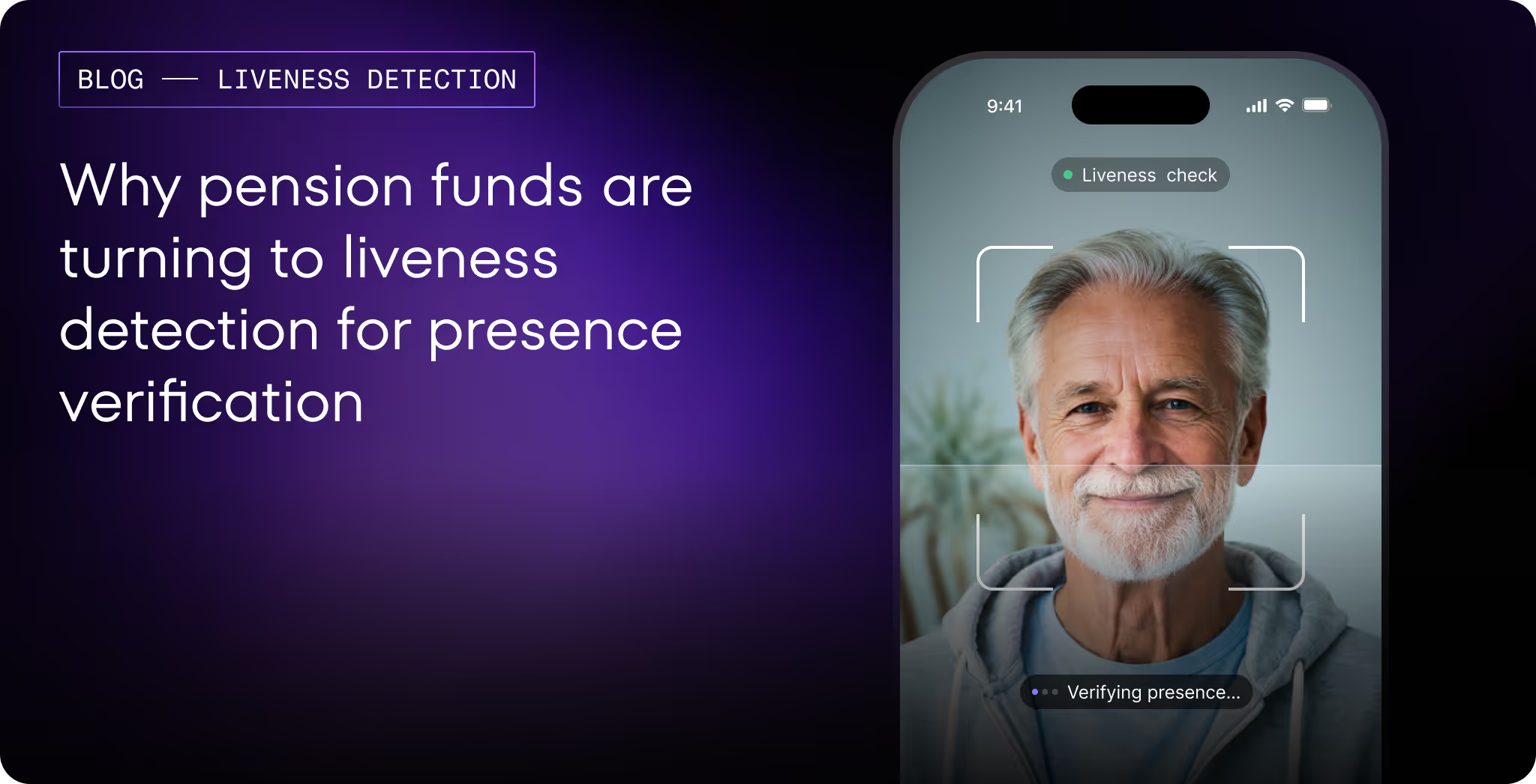
Facial recognition on its own wouldn't be enough. A printed photo of a deceased pensioner could defeat a simple face-match check. Liveness detection is what closes that gap.

The system captures a selfie in real time and checks that what the camera sees is an actual person present at that moment, not a photo, a screen replay, or a video clip. It analyzes depth, natural movement, and other cues that can't be faked by holding up an image. Once presence is confirmed, the biometric is matched against the record on file via the Philippine Statistics Authority's National ID eVerify system.

For a presence verification use case, this is the right fit. The entire point is to confirm that a specific person is alive and present at the time of verification, which is exactly what liveness detection does. It's the same technology behind Authsignal's biometric authentication, powered in part through the partnership with iProov, whose Genuine Presence Assurance confirms a real person is authenticating in real time.

The broader pattern

The Philippines isn't alone in moving this direction. The UN Pension Fund deployed biometric liveness verification across 18 countries last year, replacing a paper-based process that required retirees to physically submit forms or appear in person. Across public sector agencies, the shift is happening because manual annual confirmation doesn't scale and doesn't reliably catch fraud when it does happen.

The face biometric liveness detection market is projected to exceed $250 million by 2027, pushed by high-stakes identity verification use cases where continuous payouts depend on confirmed eligibility.

What this looks like in practice for other sectors

Pension liveness verification is a narrow case, but the underlying problem shows up in insurance, healthcare, and anywhere benefits are tied to ongoing eligibility. The question is the same: how do you verify that the person claiming something is who they say they are, and that they're actually present?

Liveness detection answers both at once. A live selfie check at the point of claim or renewal adds a layer that documents alone can't provide. The SSS approach of layering biometric verification on top of existing processes, rather than replacing them entirely, makes sense when your user base includes elderly pensioners with varying levels of digital access. You need options that work across different situations.

That same logic applies in financial services and enterprise products. As we've written about in the context of biometric passkey-binding, the strongest identity signals come from combining presence confirmation with cryptographic credentials. Biometrics don't have to be the only path through a verification flow.

Authsignal's biometric authentication integrates into verification flows without requiring a rebuild of the underlying stack. It works alongside step-up authentication, MFA, and identity verification, so you can add a biometric presence check at exactly the point in your flow where the risk is highest.

Want to see how liveness detection fits into your verification flow? Talk to the Authsignal team.

Question icon
Have a question?
Talk to an expert
NewsletterDemo PasskeysView docs
Liveness Detection
Identity Verification
Fraud prevention

You might also like

How a global real estate company strengthened MFA with Authsignal
Azure AD B2C
Multi-factor authentication
Passkeys

How a global real estate company strengthened MFA with Authsignal

April 14, 2026
What is Visa VAMP? Thresholds, fees, and how it affects your dispute ratio
Visa VAMP
Chargebacks
Dispute Management

What is Visa VAMP? Thresholds, fees, and how it affects your dispute ratio

April 13, 2026
Authsignal joins IATA Strategic Partnership Program to advance digital identity adoption in travel and aviation
Partnerships
Airlines

Authsignal joins IATA Strategic Partnership Program to advance digital identity adoption in travel and aviation

April 10, 2026

Secure your customers’ accounts today with Authsignal

Passkey demoCreate free account
Authsignal Purple Logo

Authsignal delivers passwordless and multi-factor authentication as a service. Focused on powering mid-market and enterprise businesses to rapidly deploy optimized good customer flows that enable a flexible and risk-based approach to authentication.

AICPA SOCFido Certified
LinkedInTwitter
Passwordless / multi-factor authentication (MFA)
Pre-built UI (low code)UI components (customizable)Custom UI (flexible)
Why Authsignal?
Drop-in authentication
Risk-based authentication PasskeysBiometric authenticationWhatsApp OTPSMS OTPEmail OTPMagic linksAuthenticator apps (TOTP)Push authenticationPalm biometricsDigital Credential Verification API
Rules and policies engine
User observability
Industries
Financial services
Marketplace
e-Commerce
FinTech
Crypto
View all industries
Teams
Engineers
Use cases
Account takeovers (ATO)
Go passwordless
Call center
SMS cost optimization
Existing apps
View all use cases
Identity providers (IDPs)
Amazon Cognito
Auth0
Azure AD B2C
Custom identity provider
Duende IdentityServer
Keycloak
NextAuth.js
Integrations
ASP.NET
C#
Java
Node.js
Open ID Connect (OIDC)
PHP
Python
React
Ruby
Ruby on Rails
Compare
Twilio Verify vs AuthsignalAuth0 vs AuthsignalAWS Cognito vs Authsignal + AWS Cognito
Resources
BlogDeveloper docsFree Figma mobile passkeys templateFree Figma desktop passkeys templateFree Figma webapp passkeys template
Company
About usWhy AuthsignalCareersPress releasesPartnersContact us
What is
SMS OTP
Risk Based Authentication
IP Spoofing
Passwordless authentication
Multi-Factor Authentication (MFA)
United States
+1 214 974-4877
Ireland
+353 12 676529
Australia
+61 387 715 810
New Zealand
+64 275 491 983
© 2026 Authsignal - All Rights Reserved
Terms of servicePrivacy policySecuritySystem statusCookies