
Verify every caller. %%Without asking what their dog's name is.%%
Authsignal replaces knowledge-based authentication with push verification and magic links. Agents send a secure link via SMS, email, or WhatsApp. The customer verifies on their device. Identity confirmed in seconds, not minutes.










The problem your service agents face every day
Knowledge-based authentication is broken. Your agents ask security questions that social engineers already know the answers to. Customers hate the experience. Average handle time inflates. CSAT drops. And you have no way to verify the caller is really who they say they are, whether they reach out by phone, chat, email, or social.
Authsignal replaces KBA with device-based verification. The agent triggers a secure link. The customer approves on their device. Identity confirmed in seconds.
How Authsignal fits into your stack
Orchestrate authentication at any point in the customer journey. Login, transactions, account recovery, sensitive actions.
Why customer service teams choose Authsignal
Identity verified in seconds
Verification triggers from within the agent's existing Salesforce or Amazon Connect workflow. Real-time status updates. No new tools to learn.
Works with Salesforce
Verification triggers from within the agent's existing Salesforce or Amazon Connect workflow. Real-time status updates. No new tools to learn.
Every channel, one platform
Verify callers across phone, email, SMS, WhatsApp, and Slack from a single orchestration layer. Consistent identity assurance regardless of how the customer reaches out.
Handle time drops. CSAT goes up.
Agent-triggered verification replaces the back-and-forth of knowledge-based authentication. %%Customers verify on their device in seconds. Agents see the result in their existing workflow.%%
Three ways to integrate. You pick the depth.
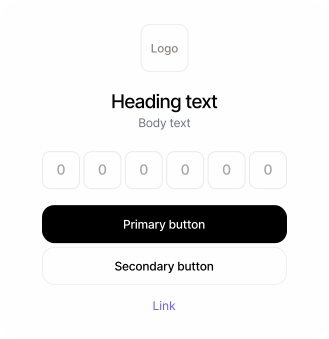
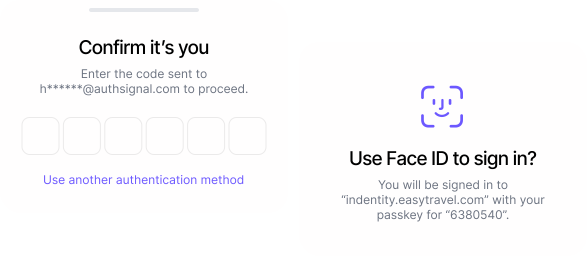
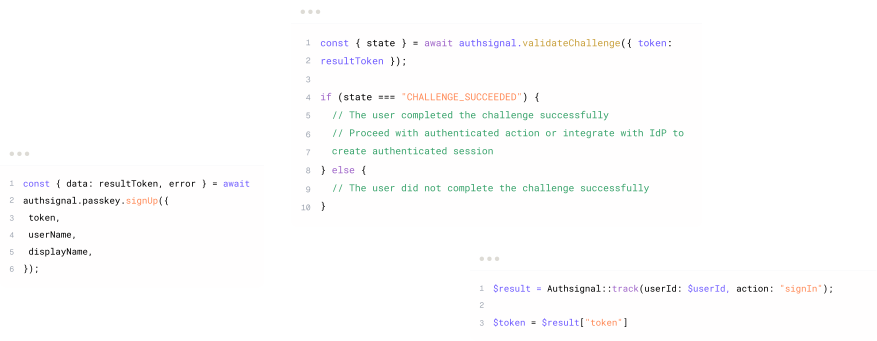
The Rules Engine: flexible, code-free control
Adapt your auth logic without touching production code.
It's like feature flags, but for authentication.
Your product and fraud teams define the rules. You build the integration once. Changes ship without your involvement.
Why call centers %%stop relying on security questions.%%
Knowledge-based authentication fails in three ways: customers forget answers, social engineers already know them, and agents waste 30+ seconds per call on questions that prove nothing.
Push verification eliminates all three. The customer proves identity with their device (passkey, biometric, or OTP). The agent sees confirmation in their existing Salesforce or Amazon Connect workflow. Average handle time drops. Fraud risk drops. CSAT goes up.
“Deploying passkeys has enhanced our security and accelerated our transition to a passwordless login experience, streamlining the customer journey.”
CTO · Simplicity
Works with your identity stack, or gives you the foundation to build one.
Authsignal drops in on top of your existing IdP. One API surface extends your identity platform across the full journey. Pick your integration guide and start building.




Enterprise-grade security without enterprise-grade complexity.
Frequently asked questions
An agent triggers a verification request from Salesforce or Amazon Connect. Authsignal sends a secure link via SMS, email, or WhatsApp. The customer verifies on their device using passkey, biometric, or OTP. The agent sees confirmation in their workflow.
Salesforce Service Cloud and Amazon Connect for agent-triggered verification. Plus all major IdPs: Auth0, Cognito, Azure AD B2C, Keycloak, Okta.
Most teams run a proof of concept in 2-5 days. Salesforce and Amazon Connect integrations are pre-built. No custom development required for the core flow.
Yes. Authsignal supports verification links via SMS, email, WhatsApp, and Slack. The customer chooses how to verify. The agent sees the result in their service platform.
Ready to verify, not interrogate?
Push verification replaces security questions. Agents confirm identity in seconds. Handle times drop. CSAT goes up. Fraud risk goes down.