
Verify every employee. %%Without asking when they were hired.%%
Authsignal replaces manual knowledge-based authentication with agent-triggered verification inside ServiceNow. Account unlocks, password resets, MFA re-enrolllment. The employee verifies on their device. Identity confirmed with a full audit trail per incident.










The problem your help desk faces every day
Your help desk agents verify employee identity by asking what they can look up in Workday: hire date, employee ID, manager name. It takes time, it's inconsistent, and it's exactly what social engineers exploit. Scattered Spider-style attacks target IT service desks because manual KBA is the weakest link. Meanwhile, Windows Hello and passwordless adoption are driving more password resets, more MFA device changes, and more verification requests through your service desk every month.
Authsignal replaces manual knowledge-based authentication with agent-triggered verification inside ServiceNow. The agent sends a secure challenge. The employee verifies on their device. Identity confirmed with a full, auditable trail per incident.
How Authsignal fits into your stack
Orchestrate authentication at any point in the customer journey. Login, transactions, account recovery, sensitive actions.
Why IT Service teams choose Authsignal
Eliminate manual KBA
Trigger verification from Interaction or Incident. Select channels. See real-time status. Full audit trail written back to the incident: time, device, IP, steps passed, steps failed, agent actions. Configurable per object type.
Native ServiceNow integration
Trigger verification from Interaction or Incident. Select channels. See real-time status. Full audit trail written back to the incident: time, device, IP, steps passed, steps failed, agent actions. Configurable per object type.
Configurable per use case
Different policies for account unlocks, password resets, and MFA re-enrolllment. Define verification flows per use case via the no-code rules engine: SMS + email for low risk, passkey + biometric for high risk, gov ID + selfie for edge cases where all factors are lost.
Watertight auditability
Every verification event logged per incident: time-stamp, device, IP/geolocation, verification steps, outcomes, agent actions. Exportable. Designed for internal audit evidence, SOC 2 compliance, and HIPAA audit trails.
Three ways to integrate. You pick the depth.
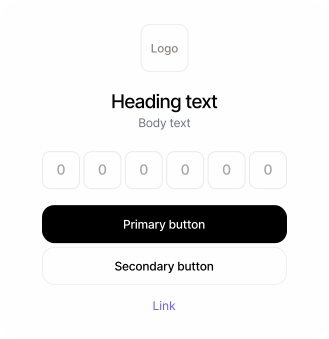
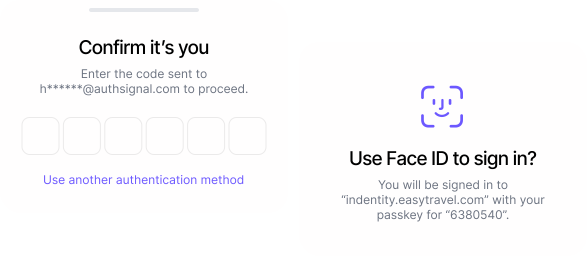
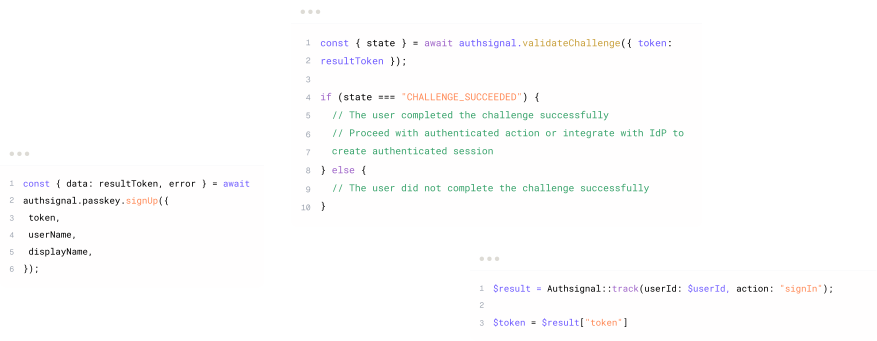
The Rules Engine: flexible, code-free control
Adapt your auth logic without touching production code.
It's like feature flags, but for authentication.
Your product and fraud teams define the rules. You build the integration once. Changes ship without your involvement.
Why service desks %%stop relying on manual KBA.%%
Manual KBA fails in three ways: it's slow (agents asking static questions that Workday could answer), it's inconsistent (every agent applies it differently), and it's exploitable (Scattered Spider-style attacks succeed precisely because help desks rely on knowledge that social engineers can obtain).
Agent-triggered verification inside ServiceNow eliminates all three. The employee proves identity on their device. %%The result is written back to the incident with a full audit trail. No human judgment required. No social engineering surface. And as passwordless adoption drives more resets and re-enrolllments, verification scales without adding headcount.%%
“Deploying passkeys has enhanced our security and accelerated our transition to a passwordless login experience, streamlining the customer journey.”
CTO · Simplicity
Works with your identity stack, or gives you the foundation to build one.
Authsignal drops in on top of your existing IdP. One API surface extends your identity platform across the full journey. Pick your integration guide and start building.




Meets SOC 2 and ISO 27001 requirements. Supports HIPAA/BAA for healthcare. Your internal audit team verifies once.
Frequently asked questions
An agent triggers a verification request from within a ServiceNow Interaction or Incident. Authsignal sends a secure challenge via SMS or email. The employee verifies on their device using passkey, biometric, or OTP. The result, including a full audit trail, is written back to the incident automatically.
Account unlocks, password resets, MFA new device enrollment and re-enrolllment, and any escalated ticket where identity must be verified. Verification can be configured per use case via the no-code rules engine, with different assurance levels for different scenarios.
The Authsignal app is available on the ServiceNow Store. Basic OTP verification can be configured in hours. Full identity flows (passkey + biometric + gov ID for edge cases) typically take 1-2 days. Plan a week for end-to-end POC including integration testing.
SMS OTP, email OTP, passkeys, biometric re-authentication (selfie match against HR photo), government ID verification (driver's license, passport), and hardware security keys (YubiKey). Methods are composable per use case via the rules engine. For example: SMS + email for account unlocks, passkey + biometric for MFA re-enrolllment, gov ID + selfie for edge cases where all factors are lost.
Ready to stop asking what you can already look up?
Agent-triggered verification inside ServiceNow replaces manual KBA. Identity confirmed on the employee's device. Full audit trail per incident. Deployed in days, not months.