Orchestrate multi-step authentication journeys with no-code branching logic, flexible verification steps and greater control over the customer experience.
Authentication has become far more complex than a single challenge at login. For financial institutions, payment providers and other consumer-facing businesses, every customer interaction carries different security requirements, and the ability to respond appropriately has become essential to both fraud prevention and customer experience.
Consider a customer checking an account balance compared with someone initiating a high-value transfer from an unfamiliar device. Both interactions require trust, but applying the same authentication process to each can either introduce unnecessary friction or leave higher-risk activities without sufficient protection.
Businesses need greater control over how authentication unfolds, including which methods are used, when additional verification is required and how customers progress through each step.
That's why we're introducing Authsignal Flows, our new visual, no-code orchestration builder that gives businesses greater control over their authentication journeys, from simple verification steps to sophisticated, multi-step experiences, all on top of their existing identity infrastructure.
From authentication decisions to complete customer journeys
Authsignal's no-code rules engine has long enabled businesses to make authentication decisions based on factors such as user, device and request context, determining when a customer should be challenged and which verification methods are appropriate.
However, many authentication requirements extend further than an individual challenge.
A financial institution might need to verify a customer using one method, evaluate the outcome and then introduce an additional factor before allowing a sensitive transaction to proceed. Other journeys may require customers to enroll in a stronger authentication method or follow different verification paths depending on how they initially authenticated.
Flows builds on Authsignal's existing rules engine by bringing these individual decisions and interactions together into a connected authentication journey.
Rather than configuring a single challenge, businesses can now design a sequence of verification steps, conditional branches and outcomes through a visual builder, giving them more flexibility to support complex authentication requirements without developing custom orchestration logic.
Build authentication your way with composable building blocks
At the center of Authsignal Flows is a visual builder that allows teams to construct authentication journeys using connected, configurable nodes.
These building blocks make it possible to define not only which authentication methods are available, but how customers move between them based on the outcome of previous steps and the conditions applied throughout the journey.
Flows supports several node types, including:
- Verification steps: Challenge customers using an authentication method they've already enrolled in.
- Enrollment steps: Introduce new authentication methods, such as passkeys, within an existing journey.
- Rule branches: Direct customers down different paths using conditions based on user, device or request context.
- Method branches: Adapt the next step according to the authentication method a customer just used.
- Manage methods: Allow customers to add, update or remove their authentication methods.
- Custom screens: Create tailored screens with custom messaging and form inputs to collect customer information, which can be saved to the user profile or used to inform subsequent steps in the journey.
- API requests: Connect third-party services and external systems directly into a Flow, allowing responses from external APIs to inform verification decisions and branching logic.
- Complete or block outcomes: Determine whether the customer can successfully finish the journey or whether the action should be denied.
By combining these components, businesses can build journeys that adapt to different security requirements, while retaining the ability to modify individual steps as their authentication strategy evolves.
From simple verification to sophisticated journeys
Not every authentication journey needs multiple steps or complex branching logic. Flows is designed to make straightforward verification just as easy to manage as more sophisticated requirements. Businesses can start with pre-built templates, view and modify existing verification configurations, or build new journeys from scratch. Whether it's a single authentication step or a multi-stage verification process, Flows provides one visual environment to manage it all.
As requirements evolve, teams can introduce additional steps, conditions and verification methods without rebuilding their existing journeys.
One flow. Every step accounted for.
For financial services, this flexibility is particularly valuable when balancing transaction security, authentication assurance requirements and customer experience.
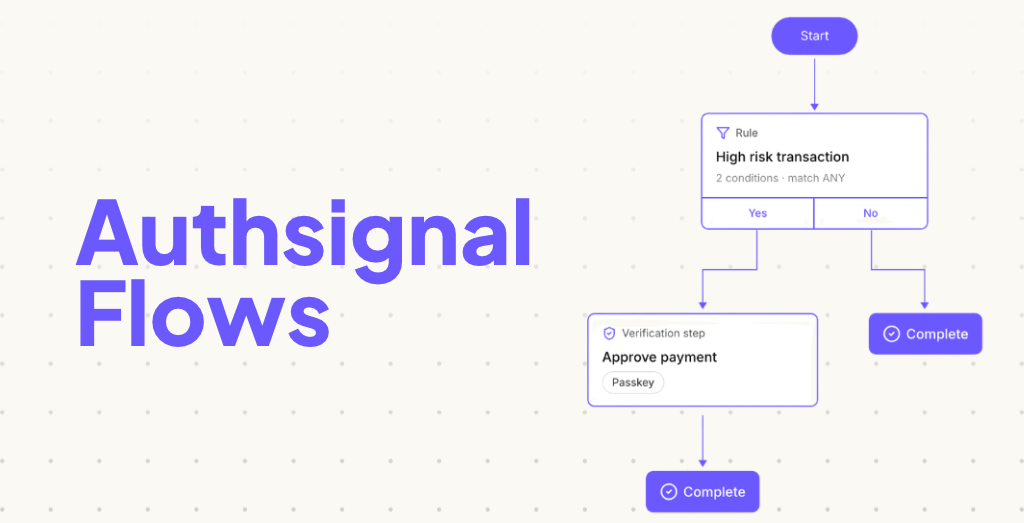
Take a money transfer application, where a customer might need only straightforward verification to access routine account functionality, but stronger authentication when transferring funds from an unfamiliar device.
Using Flows, a business can configure an initial verification step before applying branching logic to evaluate the relevant conditions. Depending on the result, the customer can either complete the journey or be directed through an additional verification step before the transaction is approved.
The same approach extends to other customer experiences. A digital credential verification journey could incorporate additional identity or biometric verification where supported and required, while a successful authentication could lead into passkey enrollment, helping customers transition to stronger methods at an appropriate moment.
For organizations managing more demanding assurance or regulatory requirements, Flows provides the flexibility to coordinate multiple authentication steps within a single journey, rather than relying on disconnected challenges or application-specific logic.
Drop-in orchestration, built around your existing infrastructure
Introducing more sophisticated authentication shouldn't require businesses to replace their existing identity systems or rebuild the applications that customers already use. Authsignal Flows operates within our drop-in authentication layer, allowing businesses to introduce multi-step journeys alongside their existing identity infrastructure.
From an implementation perspective, an application backend initiates a configured journey using the Start Flow API, which returns a challenge URL. Authsignal's pre-built UI then guides the customer through the published Flow, including any conditional branches and verification steps.
Once the journey is complete, the application can use Verify Flow to validate the returned challenge token and confirm that the required authentication steps have succeeded. This approach separates authentication orchestration from application logic, allowing teams to manage and evolve their verification journeys within Authsignal without implementing every conditional step themselves.
Built for what's next in authentication
Authentication methods will continue to evolve. From passkeys and digital credentials to emerging verification technologies, businesses will need to support new ways of establishing trust while responding to changing security requirements and customer expectations.
The challenge isn't simply adopting these methods as they become available, but being able to introduce them into existing customer journeys without repeatedly rebuilding the underlying authentication experience.
Authsignal Flows provides that flexibility, bringing verification methods, risk-based decisions and multi-step orchestration together in one visual builder. As new authentication capabilities emerge, businesses can continue adapting their journeys to deliver the right level of security and a seamless customer experience.
Build authentication your way with Authsignal Flows. Explore Authsignal Flows.